ODM Spring Loaded Test Pins Supplier & Factories

Global Engineering Excellence in Precision Micro-Contact Technologies, High-Frequency ATE Testing Interface Solutions, and Custom Smart Charger Interfaces.

Whitepaper: Industrial Dynamics and Global Procurement of Spring-Loaded Test Pins

In the rapidly advancing landscape of microelectronics, automated testing equipment (ATE), high-current charging networks, and wearable smart architecture, the demand for high-reliability contact mechanisms is scaling at an exponential rate. At the heart of these modern interfaces is the spring-loaded test pin (commonly recognized as the pogo pin). Far beyond serving as a basic mechanical component, these spring-loaded mechanisms are custom-engineered precision instruments that ensure continuous signal fidelity and low-resistance electrical connections. This industrial analysis outlines the strategic variables governing the design, manufacturing, and procurement of spring-loaded contacts, focusing on how leading Chinese factories like Shenzhen Rongqiangbin Electronic Hardware Co., Ltd. optimize production ecosystems to meet strict global benchmarks.

1. The Global Commercial & Industrial Landscape

The worldwide spring-loaded test pin and connector market is undergoing significant restructuring. Primarily driven by the transition to 5G RF hardware, consumer wearable IoT devices, automotive battery management system (BMS) interfaces, and high-frequency semiconductor probing, the precision connector segment has moved from commoditized standards to highly customized solutions.

Internationally, original equipment manufacturers (OEMs) and original design manufacturers (ODMs) are faced with the dual challenge of declining pitch boundaries and escalating durability demands. In automotive testing contexts, pogo pins must endure harsh vibration cycles, thermal extremes (ranging from -40°C to 125°C), and high current requirements without structural degradation. In consumer electronics, such as TWS bluetooth headphones or smartwatches, issues like skin sweat erosion and galvanic oxidation make advanced gold-alloy or proprietary metal plating essential. As a result, the market is turning to vertical integration, where the connector manufacturer also acts as the primary R&D partner to engineer specialized multi-pin modules, magnetic dock assemblies, and custom PCB socket layouts.

10+
Years Manufacturing Expertise
4,000+
Global Active Clients
300+
Patents and Intellectual Property
100%
Pre-shipping Electrical Test

2. Shenzhen & China's Unparalleled Industrial Cluster Advantage

China, particularly Shenzhen's Songgang region within the Guangdong-Hong Kong-Macao Greater Bay Area, represents the world's most concentrated micro-manufacturing supply ecosystem. Shenzhen Rongqiangbin Electronic Hardware Co., Ltd. (founded in February 2011) has leveraged this specialized cluster to drive continuous technical innovation. The efficiency of a Shenzhen-based pogo pin factory is based on three main pillars:

  • Micro-Machining Specialization: Access to ultra-precise Japanese CNC lathes and Swiss-type automatic turning centers allows for tight tolerances of up to ±0.005mm on custom plunger designs.
  • Sourcing Ecosystem: Proximity to premium raw materials (high-purity beryllium copper, brass, stainless steel wire, and gold target materials) simplifies supply chains, reducing material lead times from weeks to days.
  • Advanced Tooling & Prototyping: The ability to design, build, and test prototype injection molds and spring winders in-house enables the delivery of customized samples within 48 to 72 hours.

This geographic concentration translates into a competitive cost structure without sacrificing E-E-A-T principles. The integration of local high-speed plating lines, precise visual sorting equipment, and automated packaging systems allows us to maintain consistent quality across high-volume production runs.

Our Enterprise Infrastructure & Quality System

Shenzhen Rongqiangbin Electronic Hardware operates under a certified ISO9001:2015 international quality management framework. Guided by our core philosophy of "customer first, integrity first," we have built an expert engineering team that supports long-term partnerships with leading global brands. Our quality control system uses automated visual inspection, dynamic resistance meters, spring force testers, and environmental salt-spray chambers to ensure compliance with green directives (RoHS, REACH).

Honeywell
Samsung
Siemens AG
ZTE
360
QCY
Haylou
Shanghai Laimu
Luxshare Group
Aoni Electronics
Amphenol Group

3. Localized Applications & Performance Engineering

Spring-loaded test pins and connectors are critical across many modern electronic systems, each presenting unique engineering demands:

Automated Semiconductor Testing (ATE)

Double-ended pogo pins and customized IC test sockets must maintain contact resistance under 30 milliohms across hundreds of thousands of cycles at pitch widths below 0.4mm.

Medical & Life-Science Monitoring

Pins are configured with high biocompatibility coatings (e.g., thick gold-cobalt alloy plating) to ensure chemical resistance to clinical fluids and repeated sanitization cycles.

TWS Wearables & Magnetic Docks

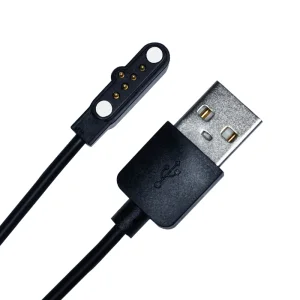
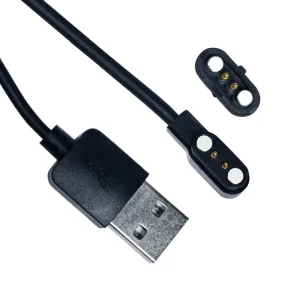
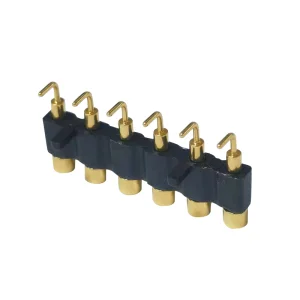
Using custom configurations like a 2-pin magnetic cable or a bent-type PCB mount socket ensures compact designs, reliable power delivery, and IP68 waterproof ratings.

4. Industrial Evolution & Technological Trends

As micro-interconnect technologies evolve, three main technological trends are defining the future of spring-loaded contacts:

  • High-Frequency / High-Speed Transmission: Standard pogo pins present inductance challenges. Next-generation designs feature coaxial shielding or customized plunger shapes to maintain signal integrity up to 10GHz, supporting 5G, 6G, and high-speed PCIe test requirements.
  • High-Current Charging Solutions (Thermal Management): To meet quick-charge demands (e.g., 5A-10A), manufacturers are using solid-center plungers with internal ball contacts or bias-tail designs. These keep the current path along the barrel wall, avoiding spring overheating and performance loss.
  • Miniaturization and Ultra-low Pitch: Mechanical components are approaching their physical limits. Manufacturing pins with a diameter of 0.2mm and a spacing pitch under 0.35mm requires specialized alloy formulations and cleanroom assembly environments.

5. Global Procurement Decision Framework

For global procurement managers at tier-1 manufacturing firms, selecting a pogo pin partner involves a strict evaluation framework. To manage risks, the criteria should extend beyond unit cost to include:

  1. Material Certification: Plungers must use raw materials like C3604 brass or beryllium copper (BeCu) C17300, and springs require music wire (SWP) or stainless steel (SUS304/316) from certified suppliers.
  2. Plating Durability: The thickness of the gold layer (typically 3 micro-inches to 30 micro-inches over a nickel barrier) directly affects oxidation rate and contact resistance. Procurement should verify this using X-ray fluorescence (XRF) test reports.
  3. Patent Portfolio: Choosing a manufacturer with a strong patent portfolio, such as Rongqiangbin’s 300+ patents, protects the supply chain from intellectual property disputes.

Enterprise Manufacturing and Quality Assurance Showcase

Below is a visual overview of our advanced facilities, production lines, and quality verification systems, demonstrating the capabilities behind our international precision supply agreements.
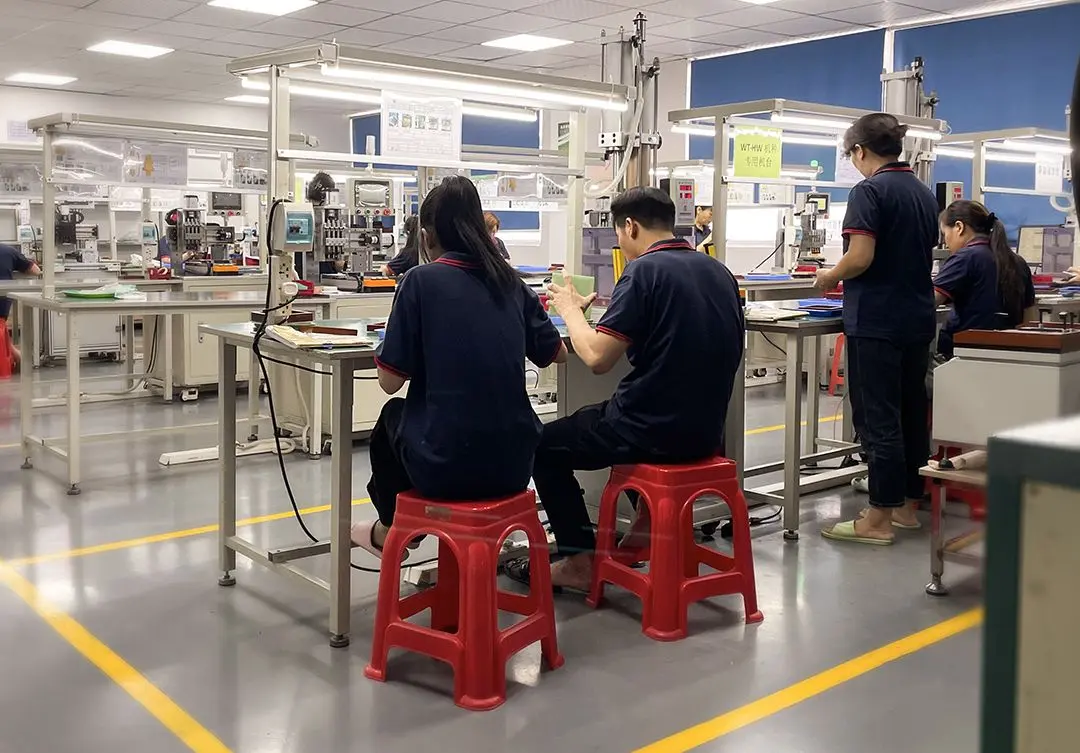
Rongqiangbin Manufacturing Facility Operations - Precision CNC Machining
Rongqiangbin Automated Assembly and Inspection Systems
Rongqiangbin Laboratory Quality Control Instruments

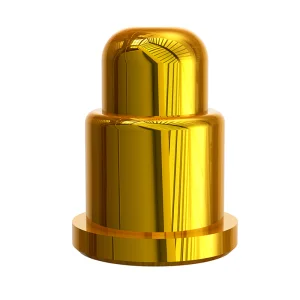
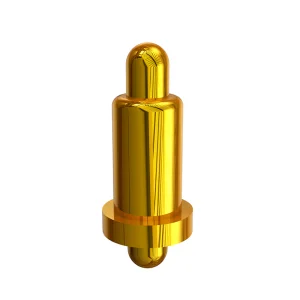
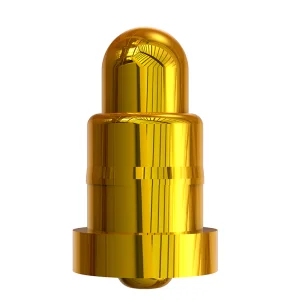
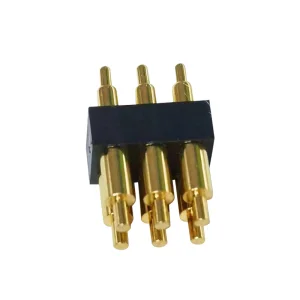
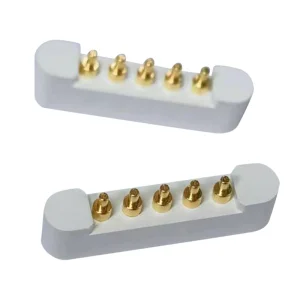
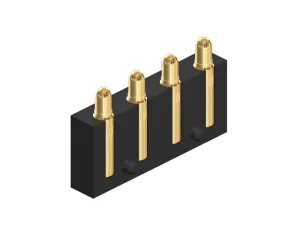
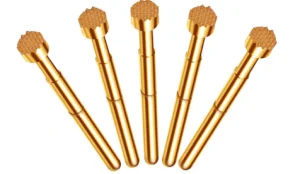
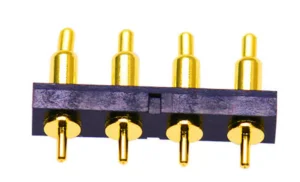
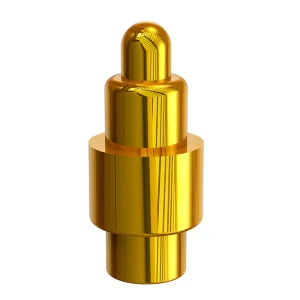
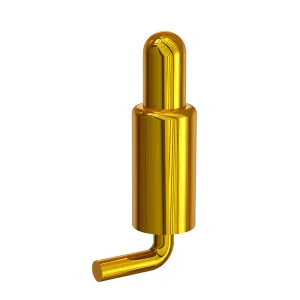
Note: To support engineering designs, Shenzhen Rongqiangbin also provides standard components, including SWP165 pin configurations, side-mounted connectors, and custom multi-pin magnetic cable setups.

Frequently Asked Questions (FAQ)

Expert answers addressing the design, manufacturing, material specifications, and quality verification of spring-loaded contact pins.

Q1: What materials are typically used for spring-loaded pins, and how do they affect performance?
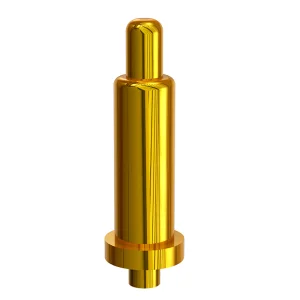
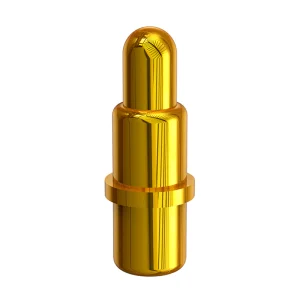
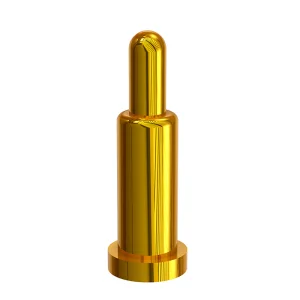
The standard structure consists of a plunger, a barrel, and an internal spring. The plunger is usually made of brass or beryllium copper (BeCu) for high conductivity and mechanical strength, plated with gold over nickel to prevent oxidation. The barrel is typically made of brass with similar plating. The spring is made of stainless steel (SUS) or music wire (SWP) for long cycle life. Choosing BeCu for the plunger provides better structural stability at smaller diameters (under 0.8mm).
Q2: How does a factory ensure low, stable contact resistance in high-current pogo pins?
To handle high currents (above 2A) without causing excessive heat, designers must prevent the current from traveling through the high-resistance spring. This is achieved by using a bias-cut plunger or inserting a small conductive ball (insulated or conductive) between the plunger and the spring. This design forces direct contact between the plunger tail and the inner barrel wall, keeping contact resistance low (typically under 20-30 milliohms).
Q3: What is the typical life cycle of a spring-loaded test pin under standard operating conditions?
Depending on the design, materials, and stroke distance, a standard spring-loaded pogo pin is designed to last between 50,000 and 1,000,000 compression cycles. Standard charging contacts for consumer wearables typically handle 50,000 to 100,000 cycles, while specialized semiconductor ATE probe pins can reach 500,000 to 1,000,000 cycles when operated within their recommended travel limits.
Q4: How do SMT (Surface Mount Technology) and DIP (Dual In-line Package) designs compare?
SMT (Surface Mount Technology) pins are designed with a flat base for automated pick-and-place assembly directly onto the surface of a PCB. This saves space and is ideal for thin consumer electronics. DIP pins feature a tail that passes through plated holes in the PCB, providing higher mechanical strength and durability. They are preferred for industrial sockets, high-stress testing boards, and heavy-duty interface docks.
Q5: Can pogo pin connectors be customized for waterproof applications?
Yes. Waterproofing (up to IP67 or IP68 ratings) is achieved by using O-ring seals, waterproof adhesives (such as epoxy potting), or overmolding the plastic housing around the pins. Additionally, the outer metal components can be plated with specialized materials like platinum or ruthenium-gold alloys to resist galvanic corrosion in saltwater or sweat-exposed environments.